




Safety Newsletter
Featured Project

Job sites are rarely quiet. Equipment runs, crews communicate, and work moves forward. Yet one kind of silence should concern every employee: the silence that follows an observed at-risk behavior. When someone sees a co-worker bypass a safeguard, enter a line of fire, use the wrong tool, not wearing correct PPE, skip fall protection, or rush a task—and says nothing—the behavior is allowed to continue. In that moment, silence is not neutral. It acts like permission.
At-risk behaviors do not always lead to an incident the first time. That is what makes them dangerous. Each time a shortcut succeeds without an immediate consequence, the shortcut can begin to feel normal. Others may copy it, and the crew’s standard slowly shifts from “the safe way” to “the way we usually get it done.” Eventually, exposure and opportunity meet. What looked like a harmless shortcut becomes an injury, property damage, or a serious near miss.
A strong safety culture is built on what people consistently do, reinforce, and tolerate. Policies and training establish expectations, but daily actions reveal the true standard. If employees believe production matters more than speaking up, or that correcting a co-worker will create conflict, hazards remain hidden. Trust declines, reporting slows, and leaders lose the opportunity to correct weak conditions before someone is hurt.
Silence also sends a message to new employees. They learn the culture by watching experienced workers and supervisors. If they see at-risk behavior ignored, they may conclude that rules are optional, coaching is unwelcome, or speaking up carries a social cost. Over time, this creates a culture of quiet compliance rather than active care. A strong culture requires the opposite: visible standards, respectful intervention, and confidence that concerns will be heard.
The front-line supervisor has the greatest day-to-day influence on whether safe behavior becomes the normal way work is performed. Crews watch what supervisors inspect, discuss, praise, and correct. A supervisor who walks past an at-risk behavior without responding unintentionally lowers the standard. A supervisor who stops, addresses the exposure, and helps the employee choose a safer method demonstrates that safety expectations are real.
Effective correction should be immediate, respectful, and focused on the behavior—not the person. The goal is not to embarrass someone; it is to remove exposure, understand why the behavior occurred, and prevent it from becoming accepted practice. A useful coaching approach is:
Accountability and enforcement turn expectations into culture. Front-line supervisors must address at-risk behavior every time, regardless of the employee, schedule, or production pressure. They should confirm the standard, correct deviations promptly, recognize safe choices, document and follow up when appropriate, and apply established consequences to repeated or deliberate violations. Enforcement must be fair, predictable, and focused on protection—not punishment for its own sake. When one person is corrected while another is allowed to ignore the same rule, credibility is lost and the crew learns that safety is negotiable. Consistent follow-through builds trust, reinforces personal responsibility, supports peer coaching, and shows that no task is important enough to bypass a safeguard. Strong supervisors combine coaching, recognition, and appropriate enforcement so safe behavior becomes the standard on every shift.
Reinforcing safe behavior is as important as correcting at-risk behavior. Front-line supervisors should recognize employees when they stop work, use the correct controls, identify a changing condition, coach a co-worker, or choose the safe method under pressure. Recognition should be timely and specific, so the employee and crew understand exactly which action met the standard. A simple statement such as, “Thank you for stopping the task and resetting it safely,” shows that speaking up and making the safe choice are valued. Consistent positive reinforcement builds trust, increases reporting and peer-to-peer coaching, and makes employees more likely to repeat safe behaviors. It also shifts the culture from one that reacts mainly to mistakes to one that actively notices, supports, and strengthens the behaviors that prevent incidents.
Supervisors cannot be everywhere. Co-workers often see changing conditions and at-risk decisions first. Peer-to-peer coaching closes that gap. A simple statement such as, “Let’s pause—I see your hand near the pinch point,” can interrupt the chain of events before an injury occurs. Speaking up communicates, “I value you enough not to let you get hurt.” Receiving coaching with professionalism communicates the same commitment in return.
When co-workers do not coach one another, small exposures remain active and opportunities to learn are lost. The person performing the task may not recognize the hazard, especially when attention is divided or the work has become routine. Other employees may assume someone else will intervene. This shared hesitation—sometimes called the bystander effect—allows preventable risk to continue unchecked.
Good peer coaching is brief, specific, and respectful:
Leaders must make this behavior safe as well. Employees should know that good-faith intervention is expected, appreciated, and protected. Supervisors can strengthen peer coaching by discussing successful interventions during pre-task meetings, thanking employees who speak up, and responding to concerns with curiosity rather than defensiveness.
An incident-free culture is not created by the absence of reported incidents alone. It is created when people actively identify exposure, intervene before harm occurs, and learn from each correction. Every respectful conversation breaks the chain between an at-risk behavior and its possible consequences. Every supervisor who addresses a shortcut reinforces the standard. Every co-worker who speaks up makes caring visible.
Silence does not prevent incidents. Courageous, respectful intervention does.
Before work begins—and whenever conditions change—ask yourself: If I see an at-risk behavior today, will I stay silent, or will I care enough to speak? The decision to speak up may take only a few seconds, but it can protect a life, strengthen trust, and move the entire organization closer to an incident-free culture.
The Palisades Scaffold Carpenter crew has been supporting the Palisades restart project for more than two years, providing scaffold construction, modifications, inspections, and demolition services across the site. Throughout the project, they have built a reputation for working safely, maintaining high standards, and supporting not only Champion personnel, but the client and numerous contractors working on site.
The crew was nominated for consistently demonstrating the principles of a strong safety culture, particularly personal accountability, a questioning attitude, and the willingness to raise concerns when something doesn’t appear right.
Most recently, while preparing to remove a scaffold as part of a planned demolition activity, the crew demonstrated amazing situational awareness and a strong questioning attitude when they identified what appeared to be unfinished work in the area. Rather than continuing with the scheduled task, they stopped, notified supervision, and requested further review. Their concern proved valid. The investigation determined that critical work had not been completed, preventing potential rework costs for the client and eliminating a potential safety risk for personnel in the area.
Their dedication and performance made a lasting impression, and the client feedback speaks for itself: “The station is very grateful for the questioning attitude displayed by the carpenters. Their behaviors were exactly what we hope for and encourage from all of our Palisades associates. Their willingness to speak up and identify an issue is a perfect example of why a safety-conscious work environment is so important. If they had not questioned this, and the condition had remained unknown, the incomplete work had the potential to be very costly to Palisades from a safety, schedule, and cost perspective.”
– Vern Jorgensen, Director, Projects & Maintenance Services, Holtec Palisades
This example of a great catch is just one of the examples of why the crew was nominated. Their willingness to challenge assumptions, speak up, and verify conditions before proceeding demonstrates the standards required on a nuclear project and reflects our exceptionals standards every day.
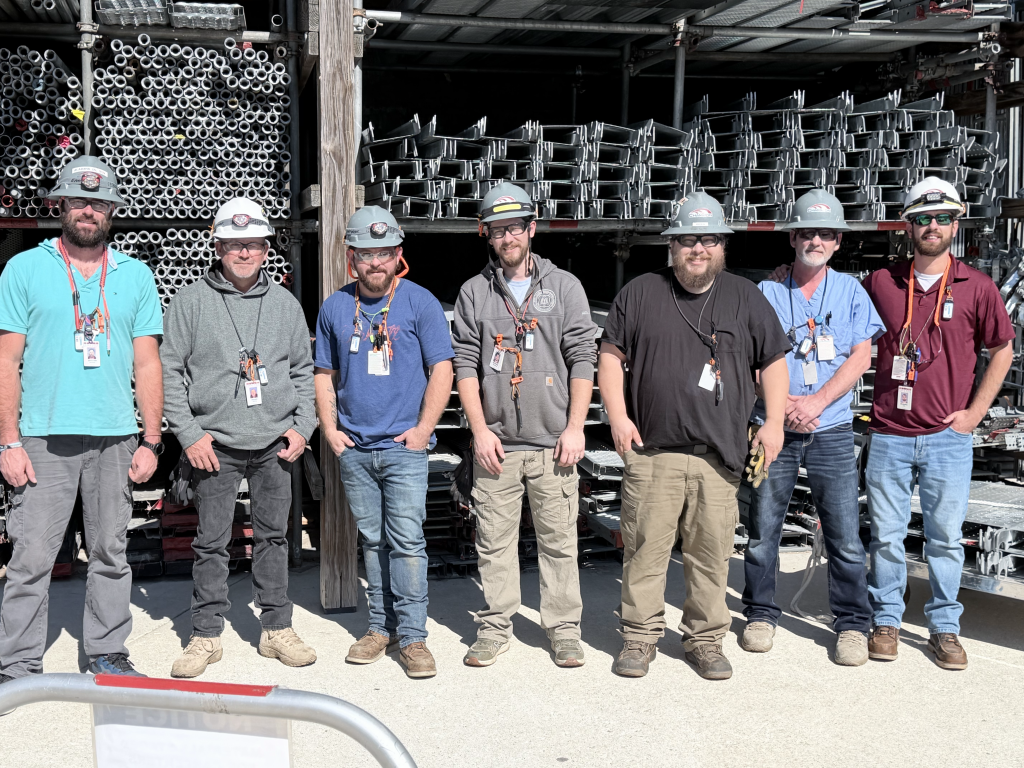
From Left: Jonathan Sorensen, Steve Jamrog (Supervisor), Stephen Blackstock, Nathan Knuckles, Elijah Knuckles, Mark Hampton, Brandon Dell ( Scaffold Coordinator)

