
Safety Newsletter
Featured Project

The core of the Target Zero philosophy is the belief that all injuries and incidents are preventable.
Unlike older safety models that viewed accidents as “part of the job” or “bad luck,” Target Zero asserts that every hazard can be identified, and every risk can be controlled. It shifts safety from a list of rules to a moral commitment: the only acceptable number of injuries is zero.
This is the most critical shift in thinking. In traditional safety, some accidents are seen as “acts of God” or “freak occurrences.” Target Zero rejects this.
Priorities change based on deadlines, budget cuts, or weather. Values do not.
Traditional safety measures success by how many people didn’t get hurt (lagging indicators). Target Zero focuses on what people are doing to stay safe (leading indicators).
In a “Zero” environment, safety is not the “Safety Officer’s” job; it is everyone’s job.
Target Zero fails if it becomes a “Zero Reporting” culture where people hide injuries to keep the streak alive.
Target Zero isn’t about following rules to avoid a fine; it’s about choosing to work safely to protect yourself and your coworkers.
A critical piece of this philosophy is that every person on site—from the intern to the CEO—has the authority and the responsibility to stop a task if they feel it is unsafe.
Target Zero relies on catching “free lessons.” A near-miss is a warning sign that a serious injury is coming.
The philosophy doesn’t end when you clock out. To truly reach zero, safety must become a habit that follows you home to your family.
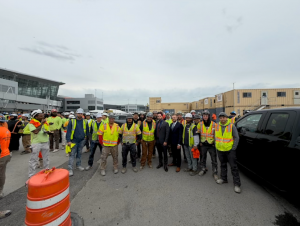
Foreman Sergio Gomes and his Champion crew recently completed an exceptional joint‑venture project for Skanska/Halmar at JFK International Airport. The JFK airport is the busiest and one of the most demanding work environments in the country. Their performance set a standout example of safety, coordination, and craftsmanship, which is why we are proud to recognize them as May’s Crew of the Month.
The team installed miles of SafeSpan cable and tubing system decking across five separate ramps, covering roughly 250,000 square feet. This system provided essential access for blasting, surface prep, and painting operations. Beginning in May 2025, the crew navigated constantly shifting airport operations and site conditions with professionalism and precision.
Even as the winter of 2025–2026 brought extreme cold and heavy snowfall, the crew maintained productivity and compliance without sacrificing quality. Their work also included power‑tool surface prep and painting of approximately 1,500 square feet of steel connections from JLG aerial lifts positioned above active roadways, these tasks requiring tight coordination with ever‑changing lane closures.
Most impressive of all, the entire project was completed with zero injuries. This achievement reflects Sergio’s leadership, the crew’s discipline, and their unwavering commitment to Champion’s safety culture.
Thank you to Foreman Sergio Gomes, Project Manager Kasee Hofler, and the entire Champion crew for their outstanding performance on the JFK Roadways and Parking Garage Project (#24107). Your dedication, professionalism, and teamwork truly exemplify what it means to be a Champion.